
Why do we need a UN convention on tax?The negotiation of the UN Framework Convention on International Tax Cooperation is a landmark opportunity to reform
June- 2024. ICRICT EVALUATION OF THE OECD/G20 TWO-PILLAR SOLUTION – June 2024
Tax avoidance by multinationals and ICRICT solutions
The current international tax system is broken and skewed towards the richest and most
powerful of our societies. This system fosters and perpetuates inequality, not only between
countries, but within countries. It does so by allowing tax havens to exist. Tax havens enable
the richest in our societies to hide their wealth using highly opaque financial services. Tax
havens also are the favored location for booking the profits of the largest and most powerful
multinationals in the world. The current system of taxing multinational corporations’ global
profits based on transfer pricing is outdated and unfair, enabling systemic tax avoidance by
large multinational corporations which deprives both developed and developing countries of
resources to invest in public services.

COMPARAISON DES VERSIONS DE L’OCDE ET DE L’ONU AOÛT 2024
In order to ensure a minimum level of taxation of intra-group payments, the G20/OECD Inclusive Framework (G20/OECD IF) and the United Nations Committee of Experts on International Tax Cooperation (UNTC) have separately developed a Subject to Tax Rule (STTR). This is a minimum tax that applies on a transactional basis to payments from source States that are subject to low nominal tax rates in the State of the payee.
The STTR is based on an understanding that where, under a tax treaty, a source State has ceded taxing rights on certain outbound payments, it should be able to recover some of those rights when the income in question is taxed (if at all) in the State of the payee (i.e. the residence State) below a certain rate.
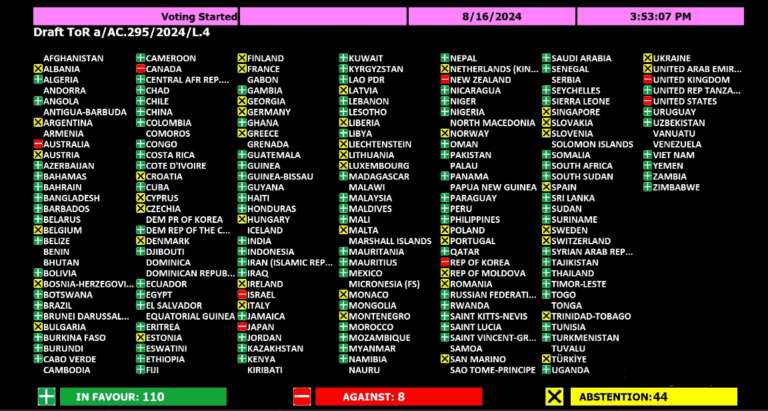
In a landmark decision, a vote at the United Nations (UN) on August 16 affirmed the will of a majority of countries to move forwards towards building a new international tax system based on fairness and inclusiveness.
The majority vote in favour of the Terms of Reference (ToRs) for a United NationsFramework Convention on International Tax Cooperation demonstrates a firmcommitment to effectively combatting tax abuse by multinational corporations and high net-worth individuals, making sure they pay their fair share.
ICRICT welcomes this vote which advances international tax cooperation in an inclusive and sustainable manner.
ICRICT welcomes the draft Terms of Reference (ToRs) of a United
Nations Framework Convention on International Tax Cooperation, and praises the
inclusive process that gave rise to it.
The vote today on the ToRs provides an historic opportunity to advance international
tax cooperation in an inclusive and sustainable manner and we encourage Member
States to vote YES to the draft as it stands.
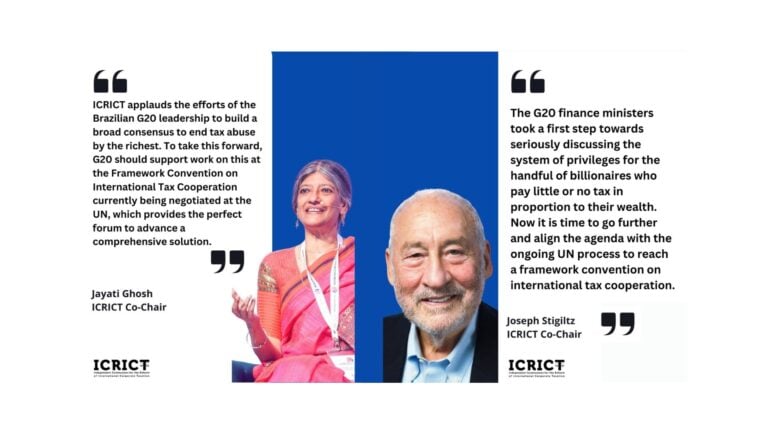
For the first time, Finance Ministers of G20 countries have acknowledged that allowing the wealthiest people in the world to pay a smaller percentage in income tax than nearly everybody else is harmful to both democracy and economic growth.
We congratulate the leadership of Brazil for putting this important issue on the table. However, we regret that the G20 finance ministers failed to agree a comprehensive and meaningful roadmap towards coordinated minimum standards. We urge G20 finance ministers and head of states to work towards a more comprehensive agenda, as the world can ill-afford to wait much longer.
ICRICT statement in response to the Chair’s request to provide written comments on the Bureau’s Proposal for the Zero Draft Terms of Reference for a United Nations Framework Convention on International Tax Cooperation, released on 7 June 2024.
As members of the Independent Commission for the Reform of International
Corporate Taxation (ICRICT), we appreciate the opportunity to provide written
comments on the Bureau’s Proposal for the Zero Draft Terms of Reference for a
United Nations Framework Convention on International Tax Cooperation.
In this world nothing is certain except death and taxes, Benjamin Franklin famously said. Billionaires may not yet have achieved immortality, but they have certainly become more agile at avoiding the tax collector. Over the last decades, globalization has opened new tax avoidance possibilities exploited by wealthy individuals around the world – and for too long, this has been accepted as an inevitable byproduct.
In the 1960s, the 400 richest Americans paid more than half of their income in taxes. Today, the super-rich control a greater share of America’s wealth than during the Gilded Age of the Carnegies and Rockefellers[1] and yet US billionaires pay only around 8% [2] of their income (induding capital gains) in personal income taxes, corresponding to about 0.5% [3] of their estimated wealth. For the first time in the history of the United States, billionaires have a lower effective tax rate than working-class Americans.